Traditional composting plants often struggle to maintain healthy profit margins. Managing massive volumes of raw compost demands significant space and constant oversight. Facilities face high storage costs and limited transportability for their bulk materials. Transforming raw organic matter into a marketable product presents a significant challenge for many operators. Raw compost is bulky, heavy, and typically restricted to localized buyer pools.
To survive and scale, plants must upgrade their existing infrastructure. They need to convert raw organic matter into uniform fertilizer granules using a commercial food waste composter and a complete granulation line. This technology revolutionizes waste management operations.
You will discover how granulation standardizes the end-product and drastically increases its retail value. We will explore how it allows for precise machine application by commercial farmers. You will also learn how this process significantly extends shelf life, unlocking lucrative agricultural markets far beyond your local zip code.
Key Takeaways
Transitioning from bulk compost to granular fertilizer increases the market value and transportability of the end product.
Effective organic waste fermentation requires precise moisture and temperature control before the granulation process can begin.
Selecting the right compost fertilizer machine line (crushing, mixing, granulating, drying) dictates the structural integrity and nutrient retention of the granules.
Partnering with an experienced Organic Waste Fertilizer Maker Supplier ensures equipment compatibility, compliance with emission standards, and long-term operational ROI.
The Business Case: Why Composting Plants Are Shifting to Granules
Operators must carefully analyze market positioning to understand profit margins. Bulk compost typically sells at a very low wholesale price. Landscapers and local nurseries buy it by the cubic yard. Premium stabilized granular fertilizer commands much higher rates. Granules represent a high-value commodity. Farmers and commercial growers gladly pay a premium for consistent nutrient delivery.
Transport and logistics also drive this transition. Bulk compost is incredibly heavy. It holds a massive amount of water weight. You can only sell it locally because freight costs quickly erase your profit margins. Granules are dry and volume-reduced. You can bag them and ship them nationwide economically.
Commercial agriculture requires application efficiency. Modern mechanical fertilizer spreaders need uniform granules to function properly. Bulk compost frequently clogs mechanical spreaders. It bridges in hoppers and causes uneven field application. Uniform granules flow smoothly through modern farming equipment. They ensure an even distribution of nutrients across large fields.
Transitioning to a granulation line requires higher upfront CapEx. However, the payback period accelerates rapidly. You gain immediate access to B2B agricultural markets rather than relying solely on local landscaping buyers.
Feature
Bulk Compost
Granular Fertilizer
Moisture Content
High (40% - 50%)
Low (Under 15%)
Transport Range
Highly localized (10-50 miles)
National/International shipping
Market Value
Low wholesale commodity pricing
Premium retail and B2B pricing
Field Application
Manual spreading or front-end loaders
Automated mechanical spreaders
Phase 1: Pre-treatment and Organic Waste Fermentation
Raw food waste requires intense pre-treatment before processing. Kitchen scraps and restaurant waste contain up to 80% moisture. They also harbor inorganic contaminants like plastics, glass, and metals. You must automate the sorting process to remove these hazards. Solid-liquid separation is critical before starting. Screw press separators effectively squeeze excess water from the raw pulp.
Rapid aerobic fermentation represents the core biological step. Proper organic waste fermentation accelerates the breakdown of complex organic matter. Commercial machines control aeration and manage internal temperatures automatically. Reaching 60-70°C kills dangerous pathogens like Salmonella and E. coli. This heat also destroys stubborn weed seeds. Mechanical agitation keeps the mixture highly oxygenated.
Post-fermentation compost remains too wet for immediate granulation. You must reduce it to an optimal moisture level. A range of 25-30% works perfectly before entering the granulator. Too much moisture creates sticky paste. Too little moisture prevents the material from binding together into a pellet.
Tip: Consistently monitor the Carbon-to-Nitrogen (C:N) ratio during fermentation. A ratio between 25:1 and 30:1 ensures rapid decomposition. It also prevents valuable nitrogen loss via ammonia off-gassing. Add carbon-rich bulking agents like sawdust if your mix becomes too wet or nitrogen-heavy.
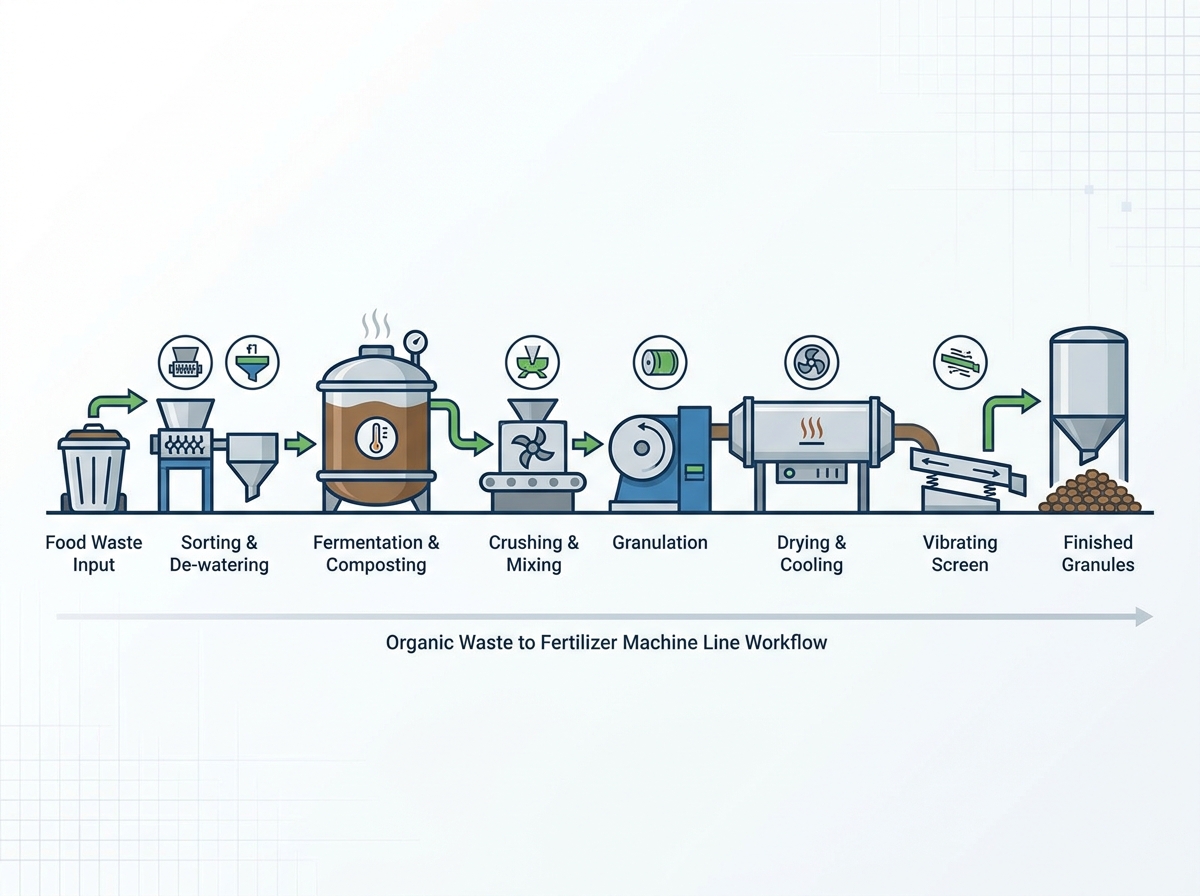
Phase 2: The Workflow of an Organic Waste to Fertilizer Machine Line
Fermented compost often forms hard clumps during the curing phase. High-moisture material crushers are necessary to break these down. These specialized chain crushers shatter clumps to achieve a fine powder. Horizontal mixers then blend the crushed material. Operators can blend in specific NPK additives if they want to create a compound organic fertilizer.
Selecting the right granulation technology determines your product quality. Compare these common granulation methods suitable for organic materials:
Disc/Pan Granulators: These machines offer high operational flexibility. Operators can visually monitor the granulation process. They use centrifugal force and a light water spray to form round balls. They work best for medium-scale plants.
Rotary Drum Granulators: These robust cylinders provide high capacity. They support continuous daily operation. The tumbling action builds strong spherical granules. They are ideal for large-scale industrial output.
Flat Die Pellet Mills: These machines press material through a steel die. They create dense, cylindrical pellets rather than round granules. This method requires lower moisture inputs and yields a high-density product.
An integrated organic waste to fertilizer machine line must include robust drying systems. Granules exit the granulator with high moisture and temperature. Rotary dryers use hot air to harden the granules rapidly. Rotary coolers then drop the temperature back to ambient levels. This dual process prevents condensation and mold during long-term warehouse storage.
Screening and coating serve as the final quality control steps. Rotary screeners separate undersized and oversized granules. The system sends rejected materials back to the crusher for reprocessing. Finally, automated coaters apply a fine anti-caking liquid or powder. This ensures the granules flow freely when farmers open the bags months later.
A modern food waste composter accelerating the fermentation process for fertilizer production.
Evaluating the Right Food Waste Composting Machine
Capacity alignment prevents expensive operational bottlenecks. You must match your input waste volume with your fermentation speed. Align these metrics carefully with your granulation throughput. Size the granulator appropriately to match the fermenter's daily output. If your fermenter produces 50 tons daily, your drying and cooling line must handle that exact load.
Assess the level of PLC (Programmable Logic Controller) integration. Modern facilities require extensive automation. Automated feeding mechanisms and digital temperature tracking reduce labor overhead significantly. Continuous discharge systems minimize human error. A fully automated food waste composting machine alerts operators via mobile devices if temperatures drop below optimal aerobic levels.
Odor and emissions control require strict attention. Food waste breakdown generates strong odors. Odors attract neighborhood complaints and regulatory fines. Ensure your equipment integrates seamlessly with industrial bio-filters or chemical scrubbers. Maintain strict compliance with local environmental regulations regarding volatile organic compounds (VOCs).
Evaluate machine durability and material construction. Food waste leachate becomes highly acidic during early fermentation. Verify vulnerable parts use high-grade stainless steel. SUS304 or SUS316 steel protects fermentation tanks and crusher blades from rapid corrosion. Mild steel components will rust and fail within a single year under these harsh acidic conditions.
ROI and Selecting a Food Waste Into Fertilizer Machine Factory
Analyze the initial cost of the machinery against ongoing operational costs. Focus specifically on the high energy consumption of the drying and cooling phases. Granulation lines require substantial electrical power. Rotary dryers often consume the most energy in the entire plant. You must balance the CapEx of premium, energy-efficient motors against long-term utility bills.
Proven track record: They must have specific experience with high-moisture food waste, not just dry animal manure.
After-sales support: They must offer rapid availability of spare parts and 24/7 technical troubleshooting.
Custom engineering: They must possess the ability to provide custom layout designs based on your existing plant footprint.
Discuss the advantages of turnkey versus piecemeal sourcing. Buying a complete, integrated production line is much safer. Sourcing everything from a single Organic Waste Fertilizer Maker Supplier ensures seamless machinery handover. The conveyors will align perfectly with the crushers. You also benefit from centralized warranties and simplified operator training.
Tip: Before committing to a large-scale purchase, request a pilot run. Send a sample of your specific food waste blend to the manufacturer’s testing facility. A lab test verifies the actual granule yield. It confirms the structural integrity of the pellets before you spend capital.
Conclusion
Converting food waste into fertilizer granules transforms a facility completely. It shifts a composting plant from a basic waste-disposal site to a high-value agricultural supplier. You capture more revenue per ton while solving massive logistical headaches.
Controlling the biological fermentation process remains vital to success. Selecting a heavy-duty granulation line ensures consistent product quality and long-term operational profitability. The machinery must withstand acidic environments while delivering uniform, dry pellets to the market.
Take action today by auditing your current waste volumes. Analyze your local bulk compost pricing against national granular fertilizer rates. Request technical consultations from reputable manufacturers to plan your facility upgrades accurately.
FAQ
Q: What is the optimal moisture content for food waste entering the granulator?
A: The optimal moisture content ranges between 25% and 30%. This specific range ensures the organic material binds together properly inside the granulator. If the material is too wet, it turns into a sticky paste and clogs the machinery. If it is too dry, the dust will not form structural pellets.
Q: Can a food waste composter process animal bones and shells?
A: Yes, but only with proper pre-treatment. You must install heavy-duty pre-crushers or hammermills before the fermentation stage. These machines pulverize dense bones and tough shells into small fragments. This increases the surface area, allowing microbes to break them down rapidly during aerobic fermentation.
Q: How much energy does a commercial compost fertilizer machine consume?
A: Energy consumption varies heavily based on plant capacity. However, the rotary drying phase consumes the vast majority of the power. De-watering and granulation use moderate electricity. You must audit local utility rates carefully, as drying wet organic matter requires significant thermal and electrical energy inputs.
Q: Is the final product considered an organic fertilizer?
A: It depends entirely on your inputs and process. If you only granulate pure fermented food waste, it classifies as an organic fertilizer. If you blend synthetic NPK chemicals into the mixer to boost nutrient profiles, it becomes an organic-inorganic compound fertilizer. Always check local regulatory definitions.