Raw powder fertilizers often create operational nightmares for modern agricultural producers. They suffer from rapid caking in storage. They lose vital nutrients easily. They also experience severe wind drift during field application. Furthermore, buyers usually price raw powders much lower than their granular equivalents. Transitioning to compacted, uniform fertilizer granules solves these persistent issues directly. It dramatically improves material handling. It extends product shelf life. It also allows you to command premium market rates.
This guide provides facility managers and investors an evidence-based evaluation framework. You will learn how to assess modern granulation technologies accurately. We will help you select the right machinery for your specific raw materials. You will discover practical methods to boost your production efficiency. Ultimately, we aim to help you build a highly profitable fertilizer processing operation.
Dry extrusion (via a double roller granulator) often yields a faster ROI for facilities looking to bypass energy-intensive drying processes.
Evaluating a powder fertilizer granulation line requires analyzing raw material moisture content, desired throughput capacity, and maintenance downtime.
Requesting accurate Granules Fertilizer Making Machine Quotes requires sharing specific raw material specs rather than just asking for a flat price.
The Business Case for Upgrading to Fertilizer Granules
Selling loose powder often leaves substantial revenue on the table. Modern farming equipment demands uniform particles. Farmers rely on mechanized spreaders to distribute nutrients evenly across their fields. Powders bridge and clog inside these machines. Granular fertilizers flow freely. Because they are easier to handle, granular products always sell at a significant market premium.
Facility compliance presents another compelling business driver. Airborne dust is a major liability. It creates severe respiratory hazards for your workforce. It coats expensive facility equipment, accelerating wear and tear. It also triggers strict environmental compliance audits. Compacting your powder drastically reduces airborne particulates. You instantly cut down on facility cleaning costs. You also minimize worker health liabilities.
The agronomic advantages heavily favor compaction as well. Soil locks up raw powders very quickly. Heavy rains easily wash fine particles away before roots can absorb them. Strong, dense granules prevent rapid nutrient lock-up. They provide a controlled, steady release. This delivers markedly better crop yields for the end-user.
Market Value: Granules command higher prices due to precision agriculture compatibility.
Operational Safety: Extrusion eliminates fine dust, protecting worker respiratory health.
Nutrient Retention: Dense particles resist heavy rain wash-off.
Tip: Calculate your current product loss due to dust and caking. This "invisible loss" often offsets the monthly financing cost of a new granulation machine.
Evaluating Technologies for Your Powder Fertilizer Granulation Line
Choosing the right processing method determines your ultimate profitability. You must evaluate technologies based on your specific material chemistry. Energy consumption plays a massive role here. A modern powder fertilizer granulation line generally falls into two distinct categories: wet granulation and dry granulation.
Wet granulation typically uses rotary drum or pan granulators. This method works best for high-moisture chemical reactions. It is highly popular for complex NPK compounding. However, wet methods carry significant drawbacks. You must add moisture to form the particles. Then, you must remove that moisture so the product does not rot or cake. This requires heavy investments in massive rotary dryers and coolers. It expands your facility footprint. It also drives your monthly energy bills exponentially higher.
Dry granulation takes a completely different approach. It works best for heat-sensitive materials or dry powders. It utilizes sheer mechanical pressure rather than liquid binders and high heat. The machine forces the powder together until it forms a solid mass. Because you skip the heating and drying phases, you protect delicate organic matter and biological additives.
Technology Type
Moisture Requirement
Energy Consumption
Facility Footprint
Wet Granulation (Drum/Pan)
High (Requires binders)
Very High (Requires dryers)
Large
Dry Granulation (Extrusion)
Low (Under 10%)
Low (Mechanical only)
Compact
Note: If your raw powder has a natural moisture content below 10%, a dry powder pelleting machine will significantly reduce your operational energy costs compared to wet methods.
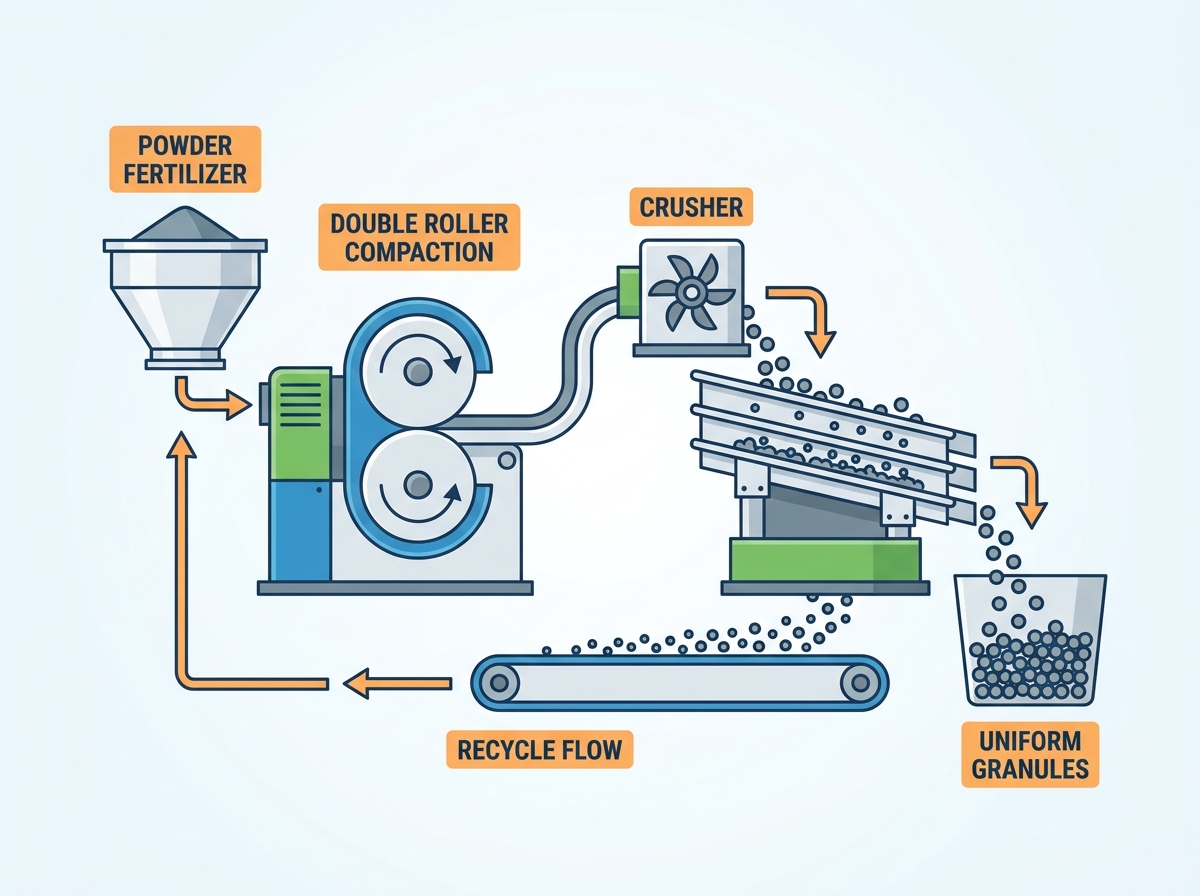
Modern granulation processes transform volatile powders into uniform, high-value agricultural products.
Deep Dive: Why the Double Roller Granulator Dominates Dry Compaction
When you opt for dry processing, one machine stands out. The double roller granulator dominates the dry compaction industry. Its robust design offers unmatched efficiency for low-moisture materials. It turns loose dust into highly profitable commodities using intense mechanical force.
The working principle relies on heavy-duty counter-rotating rollers. Here is how the process unfolds:
Feeding: A vertical feeder pushes the raw powder downward into a tight gap.
Compaction: Two massive alloy rollers squeeze the powder into a dense, solid sheet or briquette.
Crushing: Specialized blades shatter the compacted sheet into smaller, jagged fragments.
Screening: A rotary screen sorts the fragments, separating the ideal granules from fine dust.
This fertilizer granulator machine boasts incredible efficiency. It operates on a closed-loop system. Any undersized particles drop back into the feed hopper automatically. You achieve a near 100% material utilization rate. Very little product goes to waste.
However, you must manage certain implementation realities. Roller skins endure extreme friction. They eventually wear out. You must also maintain consistent feed rates. Sudden surges of material will jam the rollers and trip your electrical breakers.
Tip: When evaluating a double roller granulator, explicitly ask the manufacturer about the metallurgy of the roller skins (e.g., forged alloy steel) and the estimated tonnage lifespan before replacement is needed.
Sourcing a China Fertilizer Granules Making Machine: Risk vs. Reward
Global equipment procurement has shifted dramatically over the past decade. Chinese manufacturers now dominate the global market for fertilizer equipment. They build thousands of production lines annually. This massive scalability results in highly competitive pricing. Buying a China Fertilizer Granules Making Machine can save you immense capital upfront.
Yet, the cost advantage brings specific risks. You must look far beyond the initial price tag. Smart investors vet manufacturers rigorously. Always request documentation for ISO 9001 certifications. Check for CE marks if you operate in strictly regulated regions. You should also demand proof of proven export history to your specific continent.
Post-sale support defines the true value of your supplier. You will eventually need replacement roller skins, heavy-duty bearings, and electrical components. Determine how quickly the manufacturer can ship these spare parts overseas. Clarify their warranty terms. Ask if they provide dedicated installation assistance or commissioning engineers.
Most importantly, avoid common sourcing pitfalls. Many buyers purchase off-the-shelf "one-size-fits-all" machines blindly. They discover later that their unique powder jams the equipment. You must test your specific material formula first. Send a material sample to the factory before signing any contracts.
How to Structure and Compare Granules Fertilizer Making Machine Quotes
Procuring industrial machinery requires careful financial analysis. A surprisingly low upfront price often hides missing essential components. You cannot produce a finished product using a bare compaction machine alone. You need a complete system to maintain steady operations.
A comprehensive system quote must itemize everything required for continuous production. This typically includes raw material feeding silos. It requires bucket elevators or belt conveyors. You will need crushing units and specialized rotary screens. Finally, you need automated packaging scales to bag the finished product efficiently.
To receive accurate Granules Fertilizer Making Machine Quotes, you must share precise data. Vendors cannot design an effective line without understanding your exact constraints. Provide them with the following detailed specifications:
Raw material chemical composition and exact bulk density.
Initial moisture content percentages.
Target output capacity measured in tons per hour.
Target finished granule size (e.g., 2mm - 5mm).
Note: Be highly skeptical of quotes that do not clearly itemize the motors, gearboxes, and electrical control panel brands, as these are common areas for hidden quality compromises.
Conclusion
Investing in a robust granulation process offers a undeniable strategic advantage. You eliminate handling nightmares, extend your product's shelf life, and capture higher market premiums. Upgrading from loose powders to dense granules ultimately future-proofs your agricultural business against evolving industry standards.
Your immediate next step requires practical validation. Conduct a thorough material feasibility test. Ship a powder sample directly to your shortlisted manufacturers. Let them run it through their extrusion equipment. Review the physical hardness of the resulting samples before finalizing any major purchases.
Q: What is the ideal moisture content for dry powder granulation?
A: Usually between 2% and 5%. Higher moisture requires drying pre-treatment or a switch to wet granulation methods.
Q: How strong are the granules produced by a double roller granulator?
A: They feature high physical hardness (crushing strength), making them ideal for bulk blending and mechanized spreading without breaking back down into dust.
Q: Can one fertilizer granulator machine handle both organic and chemical fertilizers?
A: Generally, no. Organic materials often require different pressure settings, binders, and moisture management than pure chemical powders (like urea or NPK). Equipment should be tailored to the primary material.
Q: What causes a dry powder pelleting machine to block or jam?
A: Uneven feeding rates, excessive moisture in the raw material, or improper spacing between the compaction rollers. Automated variable frequency drives (VFD) on the feeder can mitigate this.