Scaling a commercial manure fertilizer plant requires highly efficient aeration and precise temperature control. You must convert raw animal waste into stable, high-value organic fertilizer safely. Relying on manual labor or undersized equipment creates significant bottlenecks. It leads to anaerobic pockets, inconsistent curing times, and lower nutrient retention in your final product. These inefficiencies slow down production and compromise quality. Selecting the correct compost fertilizer machine directly impacts your daily operational overhead. It also dictates your throughput capacity and ensures final product compliance. Facilities face strict environmental regulations today. Therefore, proper turning equipment prevents foul odors and dangerous pathogen buildup. We will explore how to analyze your site layout and evaluate different drive mechanisms. You will learn how to prioritize durability and vet reliable suppliers effectively. Let us dive into making the best equipment choice for your commercial composting facility.
Key Takeaways
Match Equipment to Layout: Choose between windrow or trench systems based on your existing facility footprint and daily manure volume.
Compare Drive Mechanisms: Understand the operational cost differences between self-propelled, tractor-pulled, and stationary rail-mounted turners.
Prioritize Durability: Manure is highly corrosive; prioritize heavy-duty, anti-corrosive materials and easily replaceable rotor blades.
Vet Supplier Competency: Assess suppliers based on parts availability, after-sales support, and proven deployment in commercial agricultural environments.
1. Analyzing Site Layout and Production Capacity
Available land heavily dictates your choice of machinery. Plant managers must evaluate their physical footprint before looking at equipment specifications. High-volume plants operating in constrained spaces generally benefit from deep-trench systems. These systems stack material deeper and utilize vertical space. Conversely, plants holding extensive acreage usually prefer open-air windrows. Windrow setups require less initial civil engineering but demand wide turning radii for vehicles.
You must accurately calculate your daily raw manure intake against the theoretical throughput of the machine. Operators frequently miscalculate this by ignoring moisture content and bulking agents. Here is a reliable framework to determine your actual capacity requirements:
Measure Daily Wet Intake: Calculate the raw tons of fresh manure arriving daily.
Factor in Bulking Agents: Add the volume of straw, sawdust, or wood chips required to reach an ideal 60% moisture ratio.
Determine Processing Windows: Divide the total daily volume by your active operating hours.
Select Throughput Specs: Match this hourly requirement to the machine's cubic-meter-per-hour rating.
Feedstock density also plays a critical role in equipment selection. Cow dung and poultry manure feature vastly different bulk densities. Poultry litter is heavy, dense, and highly nitrogenous. It requires higher horsepower and robust torque for effective turning. Dairy manure often contains higher moisture and straw bedding, creating a stringy texture. This texture demands sharp, serrated blades to prevent rotor wrapping.
Tip:Do not base your purchasing decision solely on a manufacturer's "maximum capacity" spec. Calculate your required throughput using a 20% buffer to account for high-moisture batches or heavy seasonal loads.
2. Comparing Equipment: Which Animal Manure Compost Turner Fits Your Plant?
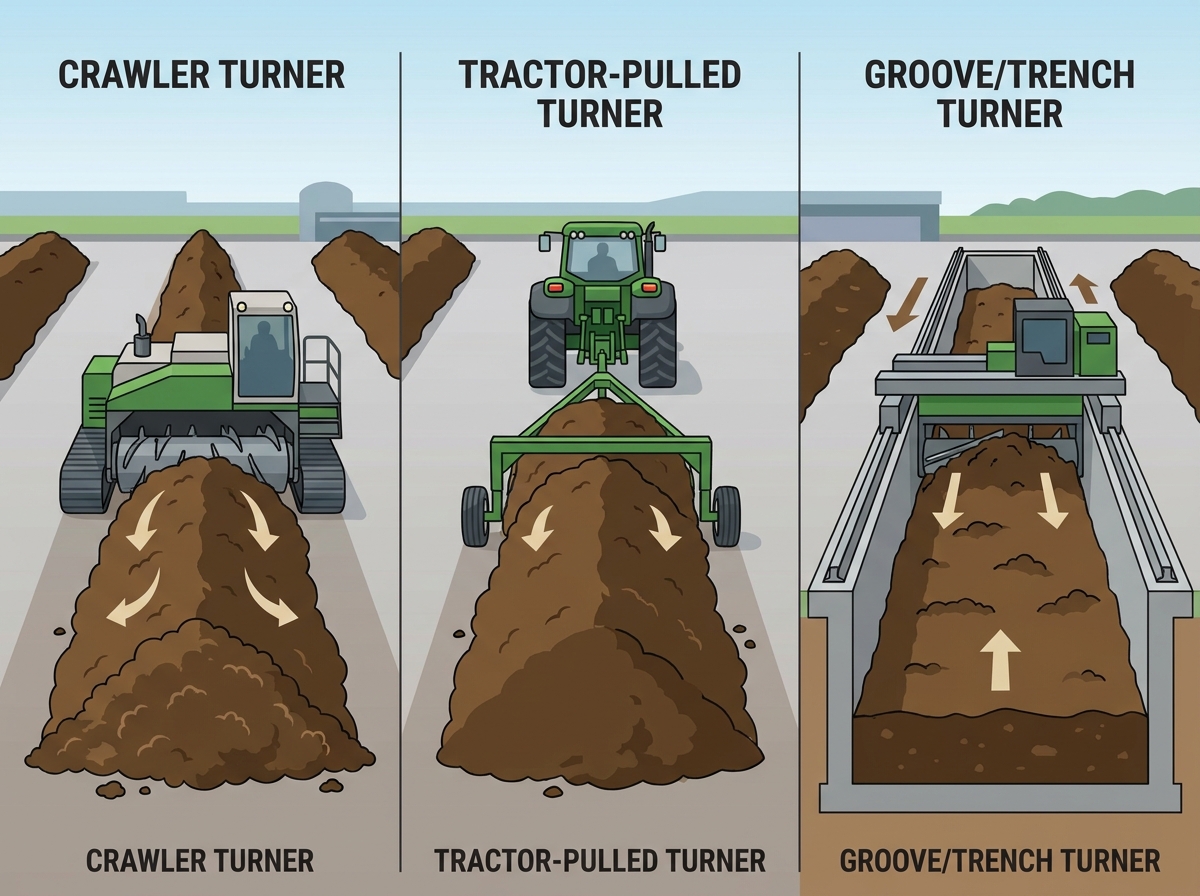
Selecting the right animal manure compost turner requires balancing your budget, site infrastructure, and labor availability. We can categorize the most viable industrial options into three main types.
Crawler Compost Turner (Self-Propelled)
This machine operates independently using a heavy-duty track-drive system. It straddles long windrows of manure to lift, mix, and aerate the material from the bottom up. Operators drive the unit directly over the pile.
The crawler compost turner offers maximum mobility across uneven terrain. It does not require a traditional steering wheel. Instead, dual-track controls allow it to perform zero-radius pivot turns in incredibly tight spaces. This makes it ideal for large-scale, unpaved outdoor windrow operations. However, these machines require higher initial capital and routine diesel engine maintenance.
Tractor Pulled Compost Turner
This mechanism acts as a tow-behind implement. It draws power directly from the PTO (Power Take-Off) shaft of an existing farm tractor. The tractor pulls the unit alongside or over the windrow.
A tractor pulled compost turner provides a lower initial capital expenditure. It remains a highly attractive option if your plant already owns suitable heavy-duty tractors. It limits dedicated machinery costs. However, it ties up tractor usage during active fermentation cycles.
Note:Tractor pulled models require a tractor equipped with a creeper gear to ensure operational speeds stay slow enough (usually under 0.5 km/h) for thorough aeration.
Groove / Trench Type Compost Turner
This stationary system runs on fixed steel rails mounted over long concrete fermentation walls. Facilities often equip these systems with a hydraulic transfer vehicle. The vehicle moves the turning unit laterally to switch between multiple parallel trenches.
This setup offers the highest space utilization per square meter. It is also the easiest system to fully automate via control panels. Operators can run it electrically, eliminating diesel exhaust inside enclosed buildings. The main drawback involves the significant upfront civil engineering costs. You must construct reinforced concrete walls perfectly parallel to support the rails.
Equipment Comparison Chart
Turner Type
Power Source
Best Facility Match
Infrastructure Needs
Crawler (Self-Propelled)
Diesel Engine
Large outdoor open fields
Minimal (flat unpaved ground)
Tractor Pulled
Tractor PTO
Farms upgrading to commercial
Moderate (needs creeper gear tractor)
Groove / Trench
Electric (3-Phase)
Enclosed, high-capacity plants
High (concrete walls, rails)
A robust turning machine actively aerating a long windrow of manure.
3. Critical Performance Metrics and ROI Factors
Evaluating raw specifications is not enough. You must look closely at the mechanical components that dictate daily performance. Return on investment heavily depends on how well the machine handles abrasive materials over time.
Rotor and Blade Design: You must assess the angle and material of the throwing blades. Raw dung is highly acidic and abrasive. High-carbon steel with anti-corrosion coating is non-negotiable for an animal waste turning unit. Standard steel will rust and degrade rapidly. Look for blades bolted onto the rotor shaft rather than welded. Bolted blades allow operators to swap worn teeth in minutes instead of grinding and re-welding components.
Aeration Efficiency: A quality machine does more than push dirt around. Evaluate the unit's ability to throw material backward and upward. It must reconstruct a highly porous, trapezoidal pile. If the rotor simply drags the manure, the core remains compacted. Compacted cores quickly turn anaerobic, releasing methane and stalling the curing process. High rotational speeds combined with optimized blade angles guarantee maximum oxygen injection.
Fuel vs. Electric Power: Compare the ongoing operational costs of your energy sources. Diesel-powered self-propelled units consume fuel daily and require oil changes, filter replacements, and belt tensioning. Three-phase electric groove turners connect directly to grid power. They typically offer lower hourly energy costs and require less engine maintenance. However, electric units limit mobility entirely to the rail system.
Maintenance Access: Downtime kills facility profitability. Prioritize machines designed for easy servicing. Use this checklist during your evaluation:
Are the primary grease points positioned externally for easy daily access?
Does the machine use standardized hydraulic fittings available at local hardware stores?
Can you replace the drive belts using off-the-shelf sizes?
Are the control panels sealed against high-humidity and corrosive ammonia gases?
4. Vetting Manufacturers and Guaranteeing Support
Sourcing heavy equipment requires diligent background checks. An unreliable supplier leaves you stranded with broken machinery and decaying manure. You must evaluate the factory's track record rigorously.
Establish strict criteria for evaluating Cow Dung Manure Making Machine Factories. Look for standard ISO 9001 certifications to guarantee consistent manufacturing quality. Ask for verifiable case studies from facilities operating in climates similar to yours. If you operate in freezing temperatures, the equipment must feature block heaters and cold-weather hydraulic fluid compatibility. Transparent manufacturers will happily provide reference contacts.
Assess the reliability of Tractor Pulled Compost Turner Suppliers by scrutinizing their warranty terms. Tow-behind units endure massive torque loads. Check if they guarantee the PTO shafts and gearboxes. Ask about their inventory of spare shear bolts. You need technical deployment support to ensure the turner perfectly matches your tractor's hitch height and horsepower.
Address shipping and installation logistics early in the negotiation. International freight costs fluctuate wildly. Ensure the equipment fits into standard 40HQ containers to avoid oversized shipping premiums. Clarify who handles on-site assembly. Determine if the manufacturer provides comprehensive operator training programs for your staff. Proper training drastically reduces early equipment failures.
Tip:Request a live video tour of the factory floor or speak to current customers before signing purchase agreements to verify actual manufacturing capabilities and post-sale responsiveness.
Conclusion
Choosing the right turning equipment dictates the success of your commercial fertilizer operation. Start by analyzing your site's physical layout and measuring your available space. Calculate your required daily capacity while factoring in bulk density and moisture levels. Choose the specific type of machine—crawler, pulled, or groove—that aligns with your infrastructure and labor pool. Finally, weigh the long-term return on investment against the upfront capital, prioritizing durability and aeration efficiency.
Your next step requires immediate action. Map out your exact windrow or trench dimensions on paper. Calculate your estimated daily manure volumes. Contact your shortlisted suppliers with a standardized Request for Proposal (RFP) detailing these exact metrics. By providing concrete data, you will receive accurate equipment recommendations and build a highly profitable, sustainable fertilizer plant.
FAQ
Q: What is the typical lifespan of the blades on an animal manure compost turner?
A: Blade lifespan heavily depends on material wear and usage hours. High-carbon steel blades typically last between 300 to 500 operating hours. Foreign debris in the manure, such as stones or concrete chunks, significantly accelerates wear. Operators should inspect blades weekly and replace them immediately when the edges dull to maintain optimal aeration efficiency.
Q: Can a tractor pulled compost turner handle heavy, high-moisture cow dung?
A: Yes, but it requires careful preparation. Heavy cow dung demands a tractor with sufficient horsepower (usually 75-120 HP depending on model width). You must use a creeper gear to maintain a slow, steady pace. Additionally, operators must add moisture-adjusting bulking agents like straw to prevent the wet dung from overwhelming the PTO shaft.
Q: How do I calculate the ROI of upgrading to a crawler compost turner?
A: Compare your current manual labor and fuel costs against the new machine's operating expenses. Factor in the drastically reduced curing time. A crawler increases throughput and triggers faster fermentation cycles. This allows you to process more batches annually. The revenue from increased premium fertilizer sales usually offsets the capital expenditure within 18 to 24 months.