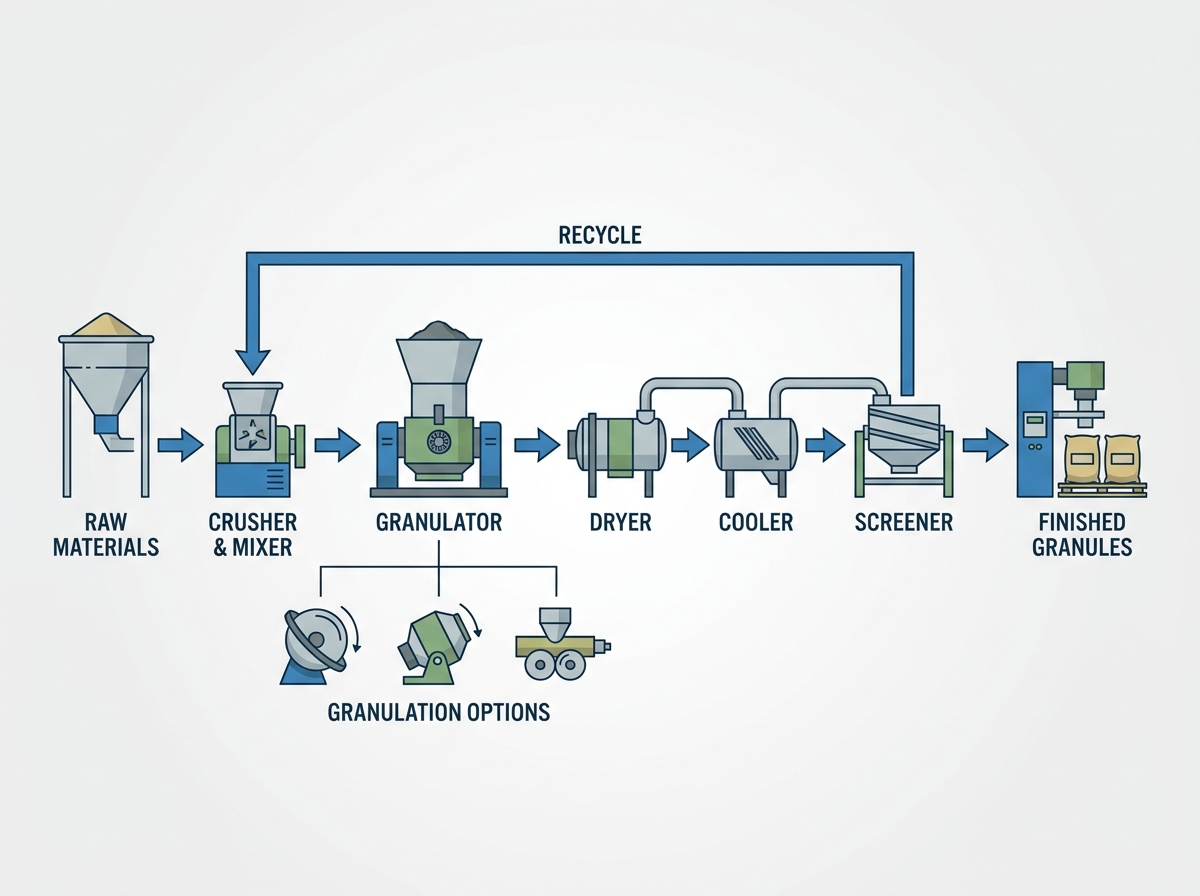
Transitioning raw organic or chemical materials into uniform, market-ready granules requires exact equipment integration. You must maintain nutrient integrity while minimizing material waste. Improperly matched machinery often causes operational bottlenecks. It leads to product inconsistencies and lost revenue. Understanding specific machine functions prevents these issues. You must know their operational limits and integration requirements. This knowledge helps you minimize downtime. It allows you to achieve a faster return on your facility investment.
Proper machinery selection dictates your final product quality. Whether you process compost or synthesize complex NPK blends, the underlying mechanics remain critical. This guide breaks down the essential equipment required for commercial fertilizer granule production. We evaluate each critical phase carefully. You will learn about everything from pre-processing raw inputs to the final packaging stage. Let us explore the optimal setup for your modern manufacturing plant.
Key Takeaways
A profitable fertilizer production line relies on perfectly synced throughput rates between crushers, mixers, and granulators to prevent operational bottlenecks.
Selecting the right fertilizer granulator machine (disc, drum, or extrusion) depends entirely on your raw material moisture content, chemical composition, and target capacity.
Sourcing a complete, integrated system from reputable Chemical Fertilizer Machine Manufacturers often yields better long-term reliability than piecemeal equipment assembly.
1. Architecting a Scalable Fertilizer Production Line
Designing an efficient fertilizer production line requires meticulous planning. You cannot simply connect machines and expect seamless operation. Plant engineering demands a synchronized approach. You must map the material flow precisely.
Defining the Baseline Flow
Every commercial facility follows a standard processing path. You must establish this critical path before purchasing equipment. A typical operational flow includes the following sequential steps:
Batching: Proportioning raw nitrogen, phosphorus, potassium, and filler materials.
Crushing: Reducing agglomerated chunks into fine powders.
Mixing: Blending powders uniformly with necessary liquid binders.
Granulating: Forming the blended powders into spherical or cylindrical pellets.
Drying: Removing excess moisture introduced during wet granulation.
Cooling: Stabilizing the hot granules to harden their exterior.
Screening: Separating ideal granules from oversized or undersized particles.
Packaging: Weighing and bagging the finished product for distribution.
Capacity vs. Footprint
Your target output directly dictates your plant footprint. A facility producing 5 tons per hour needs vastly different infrastructure than a 50-ton-per-hour plant. High-capacity lines require massive power grids. They also demand extensive heavy-duty conveyors. You must evaluate your available floor space. Vertical integration helps save ground space. Bucket elevators transport materials vertically between stages.
Material Compatibility
Organic and compound (NPK) fertilizers behave differently under mechanical pressure. They also react differently to heat. Organic compost often contains high moisture. It requires aggressive drying. NPK chemicals can melt or undergo chemical reactions if overheated. You must configure your equipment to match these specific material properties.
Common Mistake: Do not size your plant based on maximum capacities. Always size your production line based on your lowest-throughput machine. This strategy ensures continuous, uninterrupted operation. It prevents material overflow at critical choke points.
2. Pre-Processing: Sizing the Fertilizer Crusher Machine and Mixer Machine
Pre-processing prepares your raw inputs for successful binding. Poor preparation guarantees poor granulation. You must reduce particle size and ensure chemical uniformity.
Material Reduction
Raw materials often arrive clumped. They form hard blocks during transport or storage. A robust fertilizer crusher machine resolves this issue. It breaks down agglomerated raw materials to the optimal micron size. Uniform powders bind much easier than coarse chunks.
You have two primary options for material reduction:
Chain Crushers: These handle materials with slightly higher moisture. Rapidly spinning chains shatter clumps without clogging the internal chamber. They work exceptionally well for organic compost.
Cage Crushers: These feature interlocking metal cages spinning in opposite directions. They obliterate dry, brittle NPK materials. Cage crushers deliver a highly uniform particle size.
Homogenization
Once crushed, materials move to the blending phase. A heavy-duty fertilizer mixer machine ensures an even distribution of nutrients. It blends NPK powders, trace elements, and liquid binders. Homogenization guarantees that every final granule contains the exact same nutrient profile.
You generally choose between two mixer configurations:
Horizontal Ribbon Mixers: Best for dry powders. They use a helical ribbon to fold materials gently.
Twin-Shaft Mixers: Best for sticky or dense materials. Two counter-rotating shafts churn the mixture aggressively. They prevent dense particles from settling at the bottom.
Decision Criteria
You must decide between continuous mixing and batch mixing. Batch mixing offers precise control over specific recipe variations. It suits facilities producing multiple custom blends. Continuous mixing handles high-volume, single-recipe production. It requires highly automated dosing scales.
Best Practice: Match the discharge rate of your crusher directly to the intake capacity of your mixer. This precise alignment avoids material bridging. It prevents line stalling and reduces manual intervention.
Proper equipment integration ensures smooth material flow from crushing to final granulation.
3. The Core: Choosing the Right Fertilizer Granulator Machine
The granulation phase transforms raw powder into valuable pellets. Your choice of a fertilizer granulator machine dictates your entire facility layout. It determines your energy infrastructure and your final product appearance.
Disc / Pan Granulators
Disc granulators feature a large, tilted rotating pan. Operators spray liquid binder onto the powder as it tumbles. The material naturally forms spherical pellets. Disc granulators offer precise control over granule size. You can easily adjust the pan angle and rotation speed.
They remain best for flexible, mid-scale operations. However, they require higher manual oversight. An operator must monitor the pan continuously to adjust moisture levels. They represent an excellent choice for organic compost granulation.
Rotary Drum Granulators
Rotary drum granulators serve as the industry standard for high-capacity chemical fertilizer granule production. They consist of a massive, slightly inclined steel cylinder. Materials tumble through the drum while reacting with steam or chemical binders. They are ideal for steam or chemical reaction granulation.
Drum systems easily handle massive throughputs. They run continuously with minimal manual intervention. They perfectly suit large-scale NPK manufacturing plants.
Double Roller Extrusion Granulators
Extrusion granulators use a completely different mechanical principle. They represent a dry granulation method. Two massive rollers press dry powder into dense sheets. A crushing mechanism then breaks the sheet into irregular granules. This method relies purely on mechanical pressure rather than moisture.
Because you do not add liquid binders, you eliminate the need for subsequent drying and cooling stages. This drastically shrinks your plant footprint.
Granulator Comparison Chart
Use the following structural table to evaluate your granulator options quickly:
Granulator Type
Granulation Method
Typical Capacity
Drying Stage Required?
Best Application
Disc / Pan
Wet (Liquid Binder)
Low to Medium (1-6 t/h)
Yes
Organic compost, custom specialty blends.
Rotary Drum
Wet (Steam/Chemical)
High (10-30+ t/h)
Yes
Large-scale NPK, urea-based compounds.
Double Roller
Dry (Mechanical Pressure)
Medium (1-10 t/h)
No
Dry chemical powders, space-restricted plants.
Note: Your choice of granulator dictates the energy consumption of your entire facility. Wet granulation (disc and drum) requires highly energy-intensive drying phases. Dry granulation (extrusion) saves massive amounts of electricity and fuel.
4. Post-Processing: Drying, Cooling, and Screening Systems
Granules exiting a wet granulator are damp and fragile. They lack structural integrity. You must process them further to meet commercial quality standards. The post-processing stage finalizes the physical characteristics of your fertilizer granule production output.
Moisture Removal
Wet granules contain excess moisture from liquid binders or steam. You must remove this moisture to prevent caking during storage. High moisture also encourages fungal growth in organic fertilizers.
We use heavy-duty rotary dryers for this task. These massive rotating cylinders pass hot air over the tumbling granules. Internal lifting flights cascade the material continuously through the heat stream. You must reduce final granule moisture to market-compliant levels. This level typically falls under 5%. Proper drying ensures a long shelf life.
Temperature Stabilization
Granules exit the rotary dryer extremely hot. If you package them immediately, condensation forms inside the bags. This condensation ruins the product. You must utilize rotary coolers to stabilize the temperature.
Rotary coolers operate similarly to dryers. However, they pull ambient or chilled air through the cylinder. The cooling process hardens the granules immediately after drying. It locks in their structural integrity. Hard granules resist crushing during transport and field application.
Quality Assurance
Not all granules form perfectly. Some grow too large. Others remain too small. You cannot sell irregular sizes. Rotary screeners act as your final quality assurance checkpoint.
These cylindrical sieves separate the product into three streams. Perfectly sized product falls through the middle mesh and travels to the packaging machine. Oversized granules exit the front and return to a secondary crusher. Undersized powder falls through the finest mesh and returns directly to the mixer. This closed-loop system ensures zero material waste. It guarantees that only perfectly sized product reaches the final bagging phase.
5. Sourcing Strategy: Evaluating Chemical Fertilizer Machine Manufacturers
Selecting reliable equipment vendors separates successful plants from failed investments. You face a critical decision during procurement. Do you buy individual machines from different suppliers, or do you purchase an entire line from one source?
Integration vs. Piecemeal
Procuring machines piecemeal often seems cheaper initially. However, it creates massive integration headaches. A crusher from one vendor might overwhelm a mixer from another. Control systems rarely communicate seamlessly.
Purchasing a Wholesale Production Line Of Fertilizer from a single supplier offers distinct operational advantages. You achieve warranty consolidation. If a bottleneck occurs, you make one phone call. Single suppliers also provide synchronized control panels. A unified PLC (Programmable Logic Controller) system monitors the entire line centrally. It automatically adjusts conveyor speeds to prevent material clogs.
Factory Acceptance Testing (FAT): Will the manufacturer assemble and run the core machines at their facility before shipping? FAT proves the equipment functions as promised.
Spare Parts Availability: Do they maintain a robust inventory of wear parts? You need immediate access to replacement crusher blades and granulator gears.
Onsite Commissioning Support: Will they send engineers to your facility? Proper installation and calibration require specialized mechanical expertise.
Material Testing: Can they run your specific raw materials through their test machines to prove granule viability?
Compliance and Safety
Fertilizer production generates significant dust and potential chemical fumes. Ensure the manufacturer’s equipment meets your local environmental standards. Demand integrated dust collection systems. Cyclone dust collectors and wet scrubbers capture airborne particles before they exit the exhaust stacks. Proper emission controls protect your workers and prevent regulatory fines.
Tip: Demand a material test run from the manufacturer using your specific raw material blend. Do this before finalizing any equipment procurement contracts. Never assume a machine works perfectly with your unique formula until you see the physical proof.
Conclusion
Successful fertilizer production is a product of careful equipment synchronization. It relies on much more than just individual machine quality. If your crusher outpaces your granulator, your entire plant suffers. Engineering a balanced, scalable system eliminates operational headaches and maximizes product consistency.
We recommend mapping out your raw material specifications and target capacity as the absolute first step. Define your exact moisture content, chemical makeup, and hourly tonnage goals before contacting manufacturers for quotes. This data prevents vendors from undersizing your equipment.
As a clear next step, audit your current or proposed facility footprint today. Determine your local energy availability. Assess whether a highly automated wet granulation system or a compact, energy-efficient dry granulation system represents the most viable path forward for your business.
FAQ
Q: What is the most cost-effective granulator for a startup fertilizer plant?
A: Disc granulators are often preferred for smaller, budget-conscious operations. They require a much lower initial capital expenditure compared to massive rotary drums. Additionally, their open-pan design allows for easy maintenance, quick cleaning, and simple mechanical adjustments, making them highly accessible for startup teams.
Q: Does a double roller extrusion granulator require a drying machine?
A: No, it does not. A double roller extrusion granulator operates via dry extrusion. It uses intense mechanical pressure to compress dry powder into granules. This method removes the need for liquid binders, significantly reducing energy costs by eliminating the necessity for a rotary dryer and cooler.
Q: How do I prevent material buildup in my fertilizer mixer machine?
A: Preventing buildup requires strict moisture control prior to the mixing phase. You must ensure raw materials remain relatively dry before adding required binders. Furthermore, you should request specialized anti-corrosion, non-stick interior linings (like UHMW polyethylene) from your manufacturer to stop sticky NPK blends from clinging to the walls.
Q: What is the average lead time for a wholesale fertilizer production line?
A: A complete wholesale line typically takes 30 to 90 days to manufacture, depending heavily on machine scale and custom engineering requirements. You must also factor in international shipping, customs clearance, and on-site installation, which can add several additional weeks to your overall project timeline.