Introduction
The advent of modern agriculture has necessitated the development of advanced technologies to meet the growing food demands of the global population. Among these technologies, the fertilizer granulator has emerged as a pivotal tool in enhancing soil fertility and crop yields. This equipment plays a crucial role in the production of high-quality fertilizers, ensuring that essential nutrients are efficiently delivered to plants. This paper delves into the intricacies of fertilizer granulators, exploring their working principles, types, technological advancements, and their impact on sustainable agriculture.
The Significance of Fertilizer Granulators in Modern Agriculture
Fertilizer granulators are essential in transforming raw fertilizer materials into granules, which are easier to handle, store, and apply. The granulation process not only improves the physical properties of fertilizers but also enhances nutrient efficiency and reduces environmental pollution. By converting powders into granules, fertilizer granulators minimize dust generation and nutrient losses during transportation and application.
The utilization of granulated fertilizers allows for more precise application rates, leading to better nutrient management in agricultural practices. This precision is vital for optimizing plant growth, improving crop quality, and maximizing yields. Moreover, granulated fertilizers are less prone to caking and moisture absorption, which extends their shelf life and maintains their effectiveness over time.
Working Principles of Fertilizer Granulators
Fertilizer granulators operate by agglomerating fine fertilizer particles into larger, uniform granules through various mechanisms, including compression, stirring, and solidification. The core principle involves the adherence of smaller particles to form larger granules under specific conditions of moisture, temperature, and binding agents.
Agglomeration Process
The agglomeration process in fertilizer granulation typically involves wet or dry methods. In wet granulation, a liquid binder is introduced to facilitate the adhesion of particles, while in dry granulation, mechanical pressure compresses the particles together. The choice between wet and dry granulation depends on the properties of the fertilizer material and the desired characteristics of the final product.
Control of Granule Properties
The properties of the granules, such as size, density, and hardness, are critical for their performance in agricultural applications. Fertilizer granulators allow precise control over these properties by adjusting operational parameters like rotational speed, moisture content, and binder addition rates. This control ensures that the granules meet specific agronomic requirements and comply with industry standards.
Types of Fertilizer Granulators
Various types of fertilizer granulators are utilized in the industry, each with unique mechanisms and suitable for different fertilizer formulations. Understanding these types is essential for selecting the appropriate equipment for specific production needs.
Rotary Drum Granulators
Rotary drum granulators are among the most widely used granulation equipment in the fertilizer industry. They operate by tumbling the fertilizer material inside a rotating drum, where the particles coalesce into granules due to the rolling motion and the addition of a liquid binder. These granulators are suitable for large-scale production and can handle a variety of raw materials.
Disc Pan Granulators
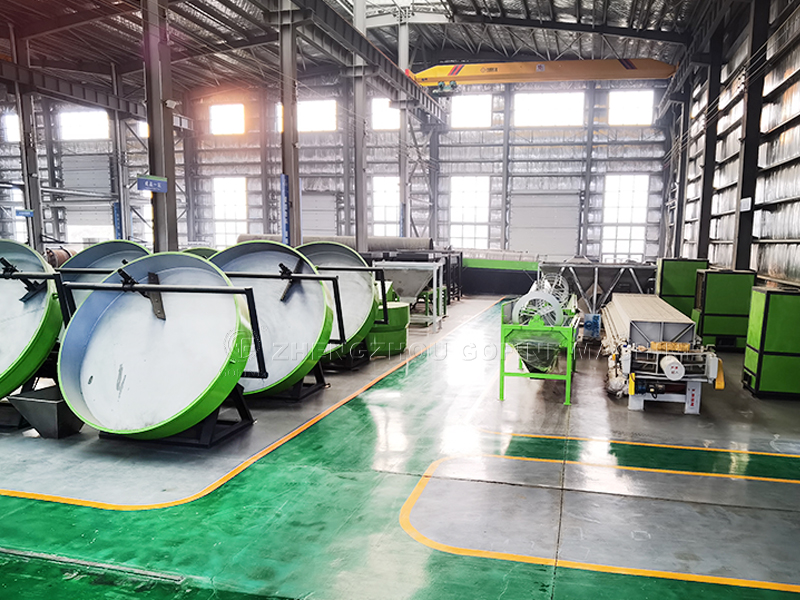
Disc pan granulators consist of an inclined rotating disc that agglomerates particles as they move along the disc surface. The angle and rotational speed of the disc can be adjusted to control granule size. This type of granulator is known for its simplicity, low cost, and ability to produce granules with a high degree of sphericity.
Double Roller Granulators
Double roller granulators utilize the dry granulation method, where materials are extruded into flakes under high pressure and then broken into granules. This equipment is ideal for heat-sensitive materials and allows for energy-efficient production without the need for drying processes. The double roller granulator is particularly effective in producing compound fertilizers.
New Type Organic Fertilizer Granulators
New type organic fertilizer granulators employ a stirring teeth mechanism to granulate organic materials. These granulators are designed to handle high-moisture content materials, making them suitable for processing livestock manure, agricultural waste, and other organic residues into valuable fertilizers. The granules produced are uniform and have high organic content, promoting sustainable agricultural practices.
Technological Advancements in Fertilizer Granulation
Recent technological advancements have significantly improved the efficiency and capabilities of fertilizer granulators. Innovations in control systems, materials engineering, and process design have led to equipment that produces higher quality granules while reducing energy consumption and environmental impact.
Automation and Control Systems
Modern fertilizer granulators are equipped with advanced automation and control systems that enable precise monitoring and adjustment of process parameters. These systems enhance product consistency, reduce human error, and allow for real-time optimization of the granulation process. Automation also facilitates scalability and integration with other production line components.
Energy Efficiency Improvements
Energy efficiency is a critical consideration in fertilizer production. Technological improvements have led to the development of granulators that consume less energy through optimized mechanical designs and the use of energy-saving components. For example, the implementation of variable frequency drives and efficient motors reduces power consumption without compromising performance.
Application in Organic and Inorganic Fertilizer Production
Fertilizer granulators are essential in both organic and inorganic fertilizer production, enabling the conversion of diverse raw materials into granulated products that are tailored to specific agricultural needs.
Organic Fertilizer Production
In organic fertilizer production, granulators process materials like animal manure, compost, and bio-waste. The granulation of organic fertilizers enhances nutrient availability and facilitates easier application. Equipment like the new type organic fertilizer granulator plays a pivotal role in producing high-quality organic pellets that support sustainable farming practices.
The use of fertilizer granulator in organic production helps in recycling agricultural waste, reducing environmental pollution, and promoting soil health. The granulated organic fertilizers improve soil structure, increase microbial activity, and enhance the long-term fertility of the soil.
Inorganic Fertilizer Production
In the production of inorganic or chemical fertilizers, granulators are used to process compounds like urea, ammonium sulfate, and phosphate into granules. The granulation process ensures uniform nutrient distribution and improves the handling characteristics of the fertilizers. Technologies such as double roller granulators and rotary drum granulators are commonly employed in inorganic fertilizer production.
Case Studies and Practical Applications
Several case studies demonstrate the successful implementation of fertilizer granulators in enhancing production efficiency and product quality. For instance, a fertilizer manufacturer implemented a rotary drum granulator, resulting in a 20% increase in production capacity and a significant improvement in granule uniformity. This change not only improved operational efficiency but also led to higher customer satisfaction due to the superior quality of the fertilizer.
Another example involves an organic fertilizer producer utilizing a new type organic fertilizer granulator to process chicken manure. The granulator effectively transformed high-moisture manure into valuable granulated fertilizer, reducing waste disposal issues and providing a sustainable product for farmers.
Benefits and Challenges of Using Fertilizer Granulators
While fertilizer granulators offer numerous benefits, including improved product quality and production efficiency, they also present certain challenges that need to be addressed.
Benefits
- Improved Nutrient Efficiency: Granulated fertilizers provide a slow and steady release of nutrients, enhancing their availability to plants and reducing the risk of leaching.
- Enhanced Product Handling: Granules are less dusty, flow more easily, and are less prone to caking, which simplifies storage, transportation, and application.
- Customizable Formulations: Fertilizer granulators allow producers to create specialized fertilizer blends tailored to specific crop requirements and soil conditions.
Challenges
- Initial Capital Investment: The cost of acquiring and installing fertilizer granulation equipment can be significant, especially for small-scale producers.
- Technical Expertise Required: Operating and maintaining granulators require trained personnel to ensure optimal performance and prevent operational issues.
- Energy Consumption: Despite advancements, granulation processes can be energy-intensive, contributing to operational costs and environmental impact.
Environmental Impact and Sustainability Considerations
Sustainability is a critical aspect of modern agricultural practices. Fertilizer granulators contribute to environmental sustainability by improving nutrient use efficiency and reducing waste. Granulated fertilizers minimize nutrient runoff into waterways, decreasing the potential for eutrophication and water pollution.
Furthermore, the use of granulators in processing organic waste into fertilizers supports recycling and reduces the environmental burden of waste disposal. By transforming agricultural and animal waste into valuable fertilizers, granulators help close the nutrient loop in agricultural ecosystems.
Nevertheless, it is essential to consider the energy consumption and emissions associated with granulation processes. Adopting energy-efficient technologies and renewable energy sources can mitigate these environmental impacts, promoting a more sustainable fertilizer production system.
Conclusion
In conclusion, the fertilizer granulator is a vital component in the modern agricultural industry, enhancing fertilizer quality, efficiency, and sustainability. By understanding the various types of granulators and their applications, producers can select the appropriate equipment to meet specific production goals. Technological advancements continue to improve granulator performance, offering opportunities for innovation in fertilizer production.
The integration of fertilizer granulators into fertilizer production lines supports sustainable agricultural practices by improving nutrient management and reducing environmental impacts. As the global demand for food continues to rise, the role of fertilizer granulators in supporting efficient and sustainable agriculture will become increasingly important.


